In January 1984, Pennzoil and Getty Oil announced an agreement in principle for Pennzoil to buy roughly three-sevenths of Getty at $110 a share. It was short. It was not the final contract. Getty's directors appear to have treated it as a gentlemen's agreement — something that would become binding once the real documents were signed.
Texaco then bought the same shares at $128. Pennzoil sued Texaco for interfering with its deal, which required convincing a jury that there had been a deal to interfere with. In November 1985 the jury awarded Pennzoil $7.53 billion in actual damages and $3 billion in punitive damages. An appeals court cut the punitive award to $1 billion and left the rest standing. Texaco filed for bankruptcy and settled for $3 billion.
A short preliminary document, described by the people who signed it as not yet binding, was read by a court as binding enough to end a company. What a document is called does not decide what it does.
So what is a memorandum of understanding?
A memorandum of understanding — an MOU — is a written record of what two or more parties have agreed in principle, written before (or sometimes instead of) a contract. It sets out who the parties are, what they intend to do together, and roughly on what terms.
People reach for one when a handshake feels too thin and a contract feels premature. Two companies exploring a partnership. A university and a hospital setting up a joint programme. A charity and a council agreeing how a service will run. Governments, for whom an MOU is usually a deliberate choice to make a commitment that is political rather than legal.
The defining feature is supposed to be that it does not bind anyone. That is the intention most of the time. It is not a guarantee.
Is a memorandum of understanding legally binding?
Usually not — but that is a description of how MOUs are typically written, not a rule of law. A court asked whether a document binds you does not look at the heading. It applies the same test it applies to anything else: was there mutual assent, was there consideration, and did these parties objectively intend to be bound?
Objectively is the word that catches people. The question is not what you privately thought you were signing. It is what your words and conduct would signal to a reasonable outsider reading the document.
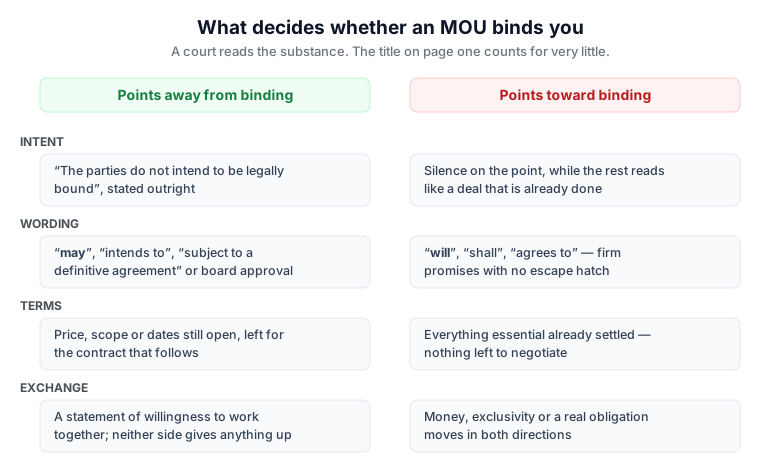
The four things a court actually weighs
- →Did you say you were not bound? An express clause — the parties do not intend this document to be legally binding — is the strongest single signal there is. Its absence is not fatal, but its presence is hard to argue around.
- →How firm is the language? May and intends to leave a choice about performing. Will, shall and agrees to do not. Conditional framing — subject to a definitive agreement, subject to board approval — tells a court the parties had not finished.
- →Is anything still open? A document missing price, scope or dates reads as a step toward a deal. One where every essential term is settled reads as the deal, whatever it is called.
- →Did anything change hands? Consideration — each side giving up something real — is the element MOUs usually lack on purpose. A promise to cooperate costs nothing. Money, exclusivity, or a genuine obligation is a different matter.
The stakes matter too. Where a breach would cause serious harm, a court is more willing to believe the parties wanted legal protection, because people do not normally leave that much riding on nothing.
The part most people miss: a non-binding MOU usually contains binding clauses
This is where the real exposure sits, and it is the thing least likely to be explained to you. Saying the MOU is non-binding does not switch off every clause inside it. Some provisions are routinely intended to bind on their own, and courts treat them that way.
| Clause | Why it usually binds anyway | What it costs you if it does |
|---|---|---|
| Confidentiality | It is pointless unless enforceable — the whole purpose is to protect what you are about to disclose. | You are under a real duty about information you shared during talks that went nowhere. |
| Exclusivity / no-shop | It is a present obligation, not a future intention: you agree to stop talking to others from today. | You cannot negotiate with anyone else for the period agreed, even if this deal collapses. |
| Costs and expenses | Who pays for what is settled now, regardless of whether the deal happens. | You may owe a share of fees for a transaction that never completes. |
| Governing law and venue | It decides where any fight happens, which only works if it survives the rest. | You may have agreed to litigate somewhere inconvenient and expensive. |
| Standstill | Same logic as exclusivity — it restrains you from a date, not conditionally. | Your freedom to act is restricted while the MOU runs. |
MOU, LOI, term sheet, contract — what is the difference?
| Document | Normally binding? | What it is for |
|---|---|---|
| Memorandum of understanding | No, by intention | Recording a shared understanding between two or more parties, often where one of them is a public body or non-profit. |
| Letter of intent (LOI) | No, by intention | Much the same job in a commercial transaction, written as a letter from one side to the other. |
| Term sheet | No, by intention | The commercial numbers of a deal on a page, common in investment and acquisitions. |
| Heads of terms | No, by intention | The UK and Commonwealth name for roughly the same document. |
| Contract | Yes | Creating obligations a court will enforce. |
A memorandum of understanding template
Here is a skeleton with the clauses that matter. Square brackets are yours to fill. The important part is section 6 — it is the clause that most downloadable templates leave out, and the one doing the work.
MEMORANDUM OF UNDERSTANDING
Between [Party A], of [address], and [Party B], of [address]. Dated [date].
1. Purpose. The parties wish to explore [describe what you are considering doing together]. This memorandum records their understanding as at the date above.
2. What each party anticipates doing. Party A anticipates [contribution]. Party B anticipates [contribution]. Use “anticipates” or “intends to” here unless you mean to be bound. “Will” and “shall” are promises.
3. Timeline. The parties intend to work toward a definitive agreement by [date]. Either party may end these discussions at any time, for any reason, on written notice.
4. Costs. Each party bears its own costs in connection with this memorandum and any negotiations, unless agreed otherwise in writing. Binding.
5. Confidentiality. Each party will keep confidential any non-public information disclosed by the other in connection with this memorandum, and will use it only to evaluate the matters described in section 1. This obligation continues for [2–3] years. Binding.
6. Legal effect. Except for sections 4, 5, 7 and 8, which the parties intend to be legally binding, this memorandum is a statement of intention only. It creates no legally enforceable obligation on either party, and neither party will be bound in respect of the matters described in section 1 unless and until a definitive written agreement is signed by both.
7. Governing law. This memorandum is governed by the law of [jurisdiction], and the courts of [jurisdiction] have exclusive jurisdiction. Binding.
8. No exclusivity. Nothing in this memorandum restricts either party from discussing similar arrangements with any third party. Delete only if you genuinely intend to grant exclusivity, and then say for how long.
Signed: ______________ [Party A] ______________ [Party B]
Section 6 does two jobs at once. It says the substance does not bind, and it names the clauses that do. A template which says only this MOU is non-binding, with a confidentiality clause sitting above it, has created exactly the ambiguity you were trying to avoid.
Before you sign one somebody else wrote
- →Find the legal effect clause first. If there is not one, that is the finding — this document's status is arguable, which usually favours whoever drafted it.
- →Read every will and shall. Each one is a promise. Ask whether you meant to make it today.
- →Check for exclusivity and standstill language, which can be phrased softly: will not solicit, will deal exclusively, will refrain from discussions with.
- →Check whether the confidentiality obligation runs both ways. One-way confidentiality in a mutual exploration is a tell.
- →Note any deadline. An MOU with no end date can sit on your file restricting you indefinitely.
- →If every essential term is already settled, ask yourself why this is an MOU and not a contract. Sometimes the answer is that one side wants the commitment without the formality.
If you want a second read on the wording, our contract clause analyzer takes a single provision and explains what it actually does, and the NDA triage tool covers confidentiality clauses specifically. Both are free, and both will tell you where they cannot help.
Common questions
Can an MOU be enforced in court?
Yes, if its contents meet the test for a contract. The label does not protect you, and Pennzoil is the expensive illustration. Equally, a well-drafted MOU with a clear legal effect clause is difficult to enforce as a whole — which is the point of writing one.
Does an MOU need consideration?
To bind, generally yes — under US and most common law systems, a promise without consideration is usually not enforceable. The absence of consideration is one reason MOUs tend not to bind. It is also why adding an exclusivity period or a payment can quietly change the document's character.
Who signs an MOU?
Someone with authority to commit the organisation to what the binding clauses actually commit it to. People sometimes let a junior manager sign an MOU because it is “only an understanding”, forgetting the confidentiality and exclusivity obligations inside it are real.
Is an MOU the same thing as an NDA?
No. An NDA does one job: protecting confidential information. An MOU describes an intended relationship and often contains a confidentiality clause as one part. If confidentiality is the only thing you need, a standalone NDA is the cleaner instrument.
Can I get out of an MOU?
From the non-binding parts, generally yes — that is what non-binding means, and a well-drafted MOU says either party may walk away. From confidentiality, exclusivity, costs and governing law, generally no. Those were binding from the day it was signed.
This is general legal information, not legal advice. Whether a particular MOU binds you turns on its exact wording, the law of the jurisdiction governing it, and what the parties did around it. The positions here reflect US and general common law practice. Where the stakes are meaningful — money, exclusivity, anything you would mind losing — the cost of an hour of a lawyer's time is small against the alternative. Texaco would agree.
Free, three analyses a day, no account needed.
Editorial note: AI For Legal Research publishes independent content. We do not accept payment for editorial coverage or review scores. Nothing on this site constitutes legal advice. Always consult a qualified attorney for legal matters.