News reports say one person was "charged" and another was "indicted." The words are not interchangeable. They describe two different steps, and sometimes two different routes to the same place.
Short answer: "Charged" is the broad term. It means a prosecutor has formally accused someone of a crime in a court document. "Indicted" is one specific way of being charged: a grand jury reviewed the evidence and agreed there is enough to go forward. Everyone who is indicted has been charged. Not everyone who is charged has been indicted.
What "Charged" Means
To be charged is to be formally accused of a specific crime. The accusation is written in a charging document and filed with a court. From that point on, there is a criminal case against you.
There are three kinds of charging documents:
- →Complaint: the first document in most cases. The prosecutor files it, often within a day or two of an arrest. Misdemeanors often stay on a complaint all the way through.
- →Information: filed by a prosecutor, usually after a judge holds a preliminary hearing and finds enough evidence for a felony case.
- →Indictment: issued by a grand jury after hearing the prosecutor's evidence.
All three count as being "charged." The difference is who approved the accusation, and how.
What "Indicted" Means
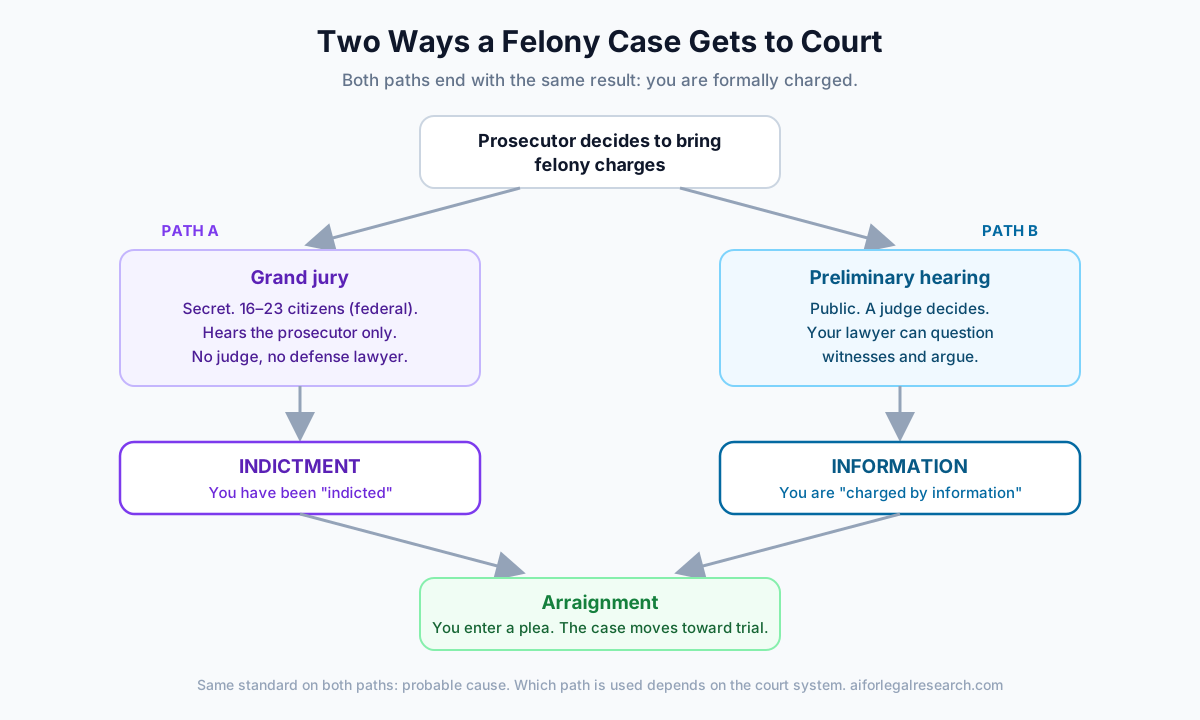
To be indicted is to be charged by a grand jury. A grand jury is a group of ordinary citizens. In federal court it has 16 to 23 members, and at least 12 must agree before an indictment issues.
A grand jury does not decide guilt. It answers one question: is there probable cause to believe a crime was committed and that this person committed it? If the answer is yes, it returns an indictment, sometimes called a "true bill." If the answer is no, it returns a "no bill," and those charges do not go forward on that indictment.
Grand juries work very differently from trial juries:
- →The proceedings are secret. The public and the press are not allowed in.
- →Only the prosecutor presents. There is no judge in the room and no defense lawyer arguing the other side.
- →The person being investigated usually has no right to appear or present evidence.
- →The standard is probable cause, which is far lower than the "beyond a reasonable doubt" needed to convict.
Because the process is one-sided, grand juries agree with prosecutors in the overwhelming majority of cases. An indictment tells you a prosecutor persuaded a grand jury. It tells you very little about how a trial will turn out.
The Two Paths, Side by Side
For a felony, a case usually reaches court by one of two routes. The chart shows both.
| Indictment | Information | Complaint | |
|---|---|---|---|
| Who approves it | Grand jury | Prosecutor, after a judge's finding | Prosecutor |
| Open to the public | No, secret | Yes, the hearing is public | Yes |
| Defense lawyer takes part | No | Yes, can question witnesses | Not at filing |
| Standard of proof | Probable cause | Probable cause | Probable cause |
| Typical use | Federal felonies; felonies in some states | Felonies in many states | Misdemeanors; the first step in most cases |
Why Some Cases Are Indicted and Others Are Not
It depends on which court system handles the case.
Federal court. The Fifth Amendment requires a grand jury indictment for serious federal crimes. So nearly every federal felony case is indicted, unless the defendant agrees to give up that right. When they do, the prosecutor files an information instead. That usually happens as part of a plea deal.
State court. The Supreme Court held in 1884, in Hurtado v. California, that the grand jury requirement does not bind the states. Each state sets its own rule. Some, such as New York and Texas, require an indictment for felonies. Others, such as California, usually use a preliminary hearing and an information, and keep the grand jury for a small number of cases.
Prosecutors in states that allow both sometimes choose a grand jury on purpose. The secrecy lets them hear from witnesses without revealing their case, and it spares a victim from testifying in open court and facing cross-examination before trial.
Is Being Indicted Worse Than Being Charged?
Not in any legal sense. An indictment and an information have the same effect. Either one starts a felony prosecution, and the penalties for the crime are the same whichever document is used.
It can feel worse, and there is one practical reason. An indictment usually means the investigation was substantial enough to bring to a grand jury, and federal indictments often follow months of work. But the word itself does not signal a stronger case or a worse outcome.
Neither one means guilt. A person who is charged or indicted is presumed innocent until the government proves the case beyond a reasonable doubt, or the person pleads guilty.
Arrested Is Not the Same as Charged
This is the most common mix-up. Police arrest people. Prosecutors charge them. They are separate decisions made by different people.
A person can be arrested and released without ever being charged, because the prosecutor decides the evidence is too weak. And a person can be charged without being arrested first. Many indictments are the first time someone learns they are being prosecuted.
There are also time limits. In federal cases, the Speedy Trial Act generally requires an indictment or information within 30 days of an arrest on a federal complaint. States have their own deadlines for filing charges after an arrest, often measured in days.
What Happens After an Indictment
- →Notice: you are either arrested on a warrant or sent a summons to appear. Some indictments are sealed, meaning kept secret until the person is in custody.
- →Arraignment: you appear before a judge, hear the charges, and enter a plea, usually not guilty at this stage. Bail or release conditions are set.
- →Discovery: the prosecution must share its evidence with the defense.
- →Motions: your lawyer can ask the court to throw out evidence or dismiss charges.
- →Plea or trial: most cases end in a plea agreement. The rest go to trial, where a different jury decides guilt.
If You Have Been Charged or Indicted
Get a criminal defense lawyer as early as you can. If you cannot afford one, ask for a public defender at your first court appearance; you have a right to one in any case that could send you to jail. Do not talk about the case with police, investigators, or anyone else except your lawyer. If you receive a federal "target letter" saying you are the subject of a grand jury investigation, contact a lawyer before responding. That is often the last point where the outcome can still be shaped before charges are filed.
Paste the text of a complaint, information, or indictment for a plain-English explanation. Legal information, not legal advice.
Frequently Asked Questions
What is the difference between indicted and charged?
Charged means formally accused of a crime in a court filing. Indicted means the charges were approved by a grand jury. An indictment is one type of charge.
Does being indicted mean you are guilty?
No. A grand jury only decides whether there is probable cause to proceed. Guilt is decided later, by a trial jury or a judge, under the much higher standard of proof beyond a reasonable doubt.
Can you be indicted without knowing?
Yes. Grand jury proceedings are secret, and an indictment can be sealed until the person is arrested. Some people learn of an indictment only when a warrant is served. In federal cases, a person may receive a target letter beforehand, but prosecutors are not required to send one.
Can charges be dropped after an indictment?
Yes. A prosecutor can ask the court to dismiss an indictment, and a judge can dismiss charges for legal defects or constitutional violations. Charges can also be reduced or dismissed as part of a plea agreement.
What does it mean when a grand jury returns a "no bill"?
It means the grand jury did not find probable cause, so it declined to indict. The case does not proceed on those charges at that time. In most places a prosecutor can present the case to a grand jury again, though it is uncommon.
Is an arrest the same as being charged?
No. An arrest is a decision by police to take someone into custody. Being charged is a decision by a prosecutor to file a formal accusation. People are sometimes arrested and never charged, and sometimes charged without an arrest.
This article is general legal information, not legal advice. Criminal procedure varies between federal court and each state, and the details of your case matter. If you are under investigation or facing charges, speak with a criminal defense attorney or public defender.
Editorial note: AI For Legal Research publishes independent content. We do not accept payment for editorial coverage or review scores. Nothing on this site constitutes legal advice. Always consult a qualified attorney for legal matters.