Case Brief Generator
Paste a court opinion and receive a formatted case brief covering facts, procedural posture, issue, holding, reasoning, and the portable rule. Adapted from Anthropic's claude-for-legal law-student skill.
Free to try — one analysis per day before upgrading. Outputs are legal information, not legal advice.
Drag & drop a file here, or click to browse
Your content stays private. What you paste or upload is sent directly to Claude (Anthropic's AI) to generate the analysis — it is never stored on our servers, logged to a database, or seen by our team. Anthropic processes it under their Privacy Policy. Do not submit confidential or highly sensitive information unless your organization's AI use policy permits it.
Legal information, not legal advice. This tool helps you understand your situation and prepare your next steps — it does not replace advice from a lawyer who knows your full circumstances. Verify anything important against official sources, and consult a licensed attorney before decisions with significant legal or financial consequences. Do not input confidential client information. Outputs are generated by Claude and may contain errors.
What Is the Case Brief Generator?
Case briefing is one of the most fundamental — and time-consuming — skills in legal education and practice. Whether you are a 1L preparing for cold calls, a litigator building a case file, or a practitioner researching precedent in an unfamiliar area, reading and distilling court opinions into usable briefs is essential work. This tool does it in seconds.
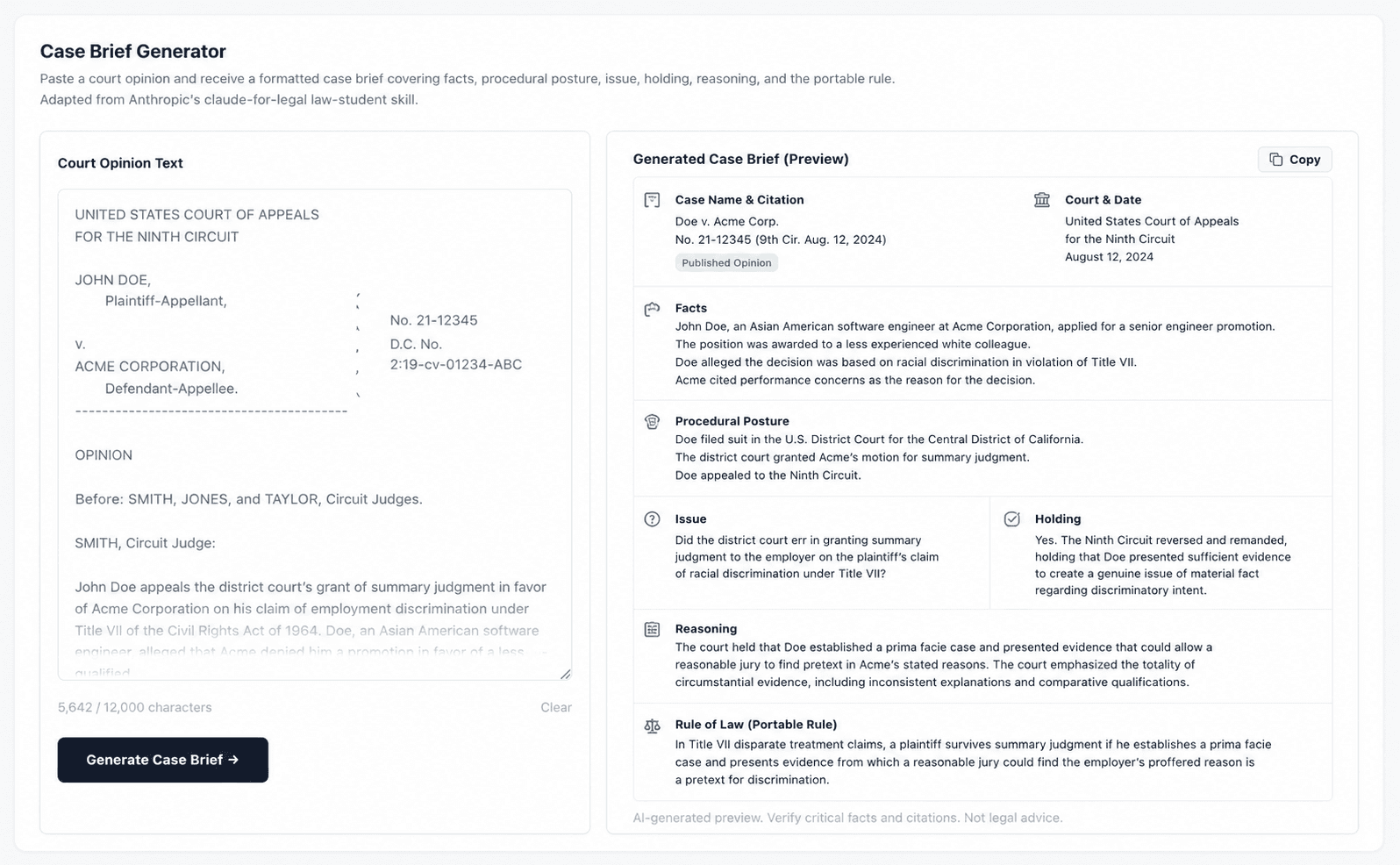
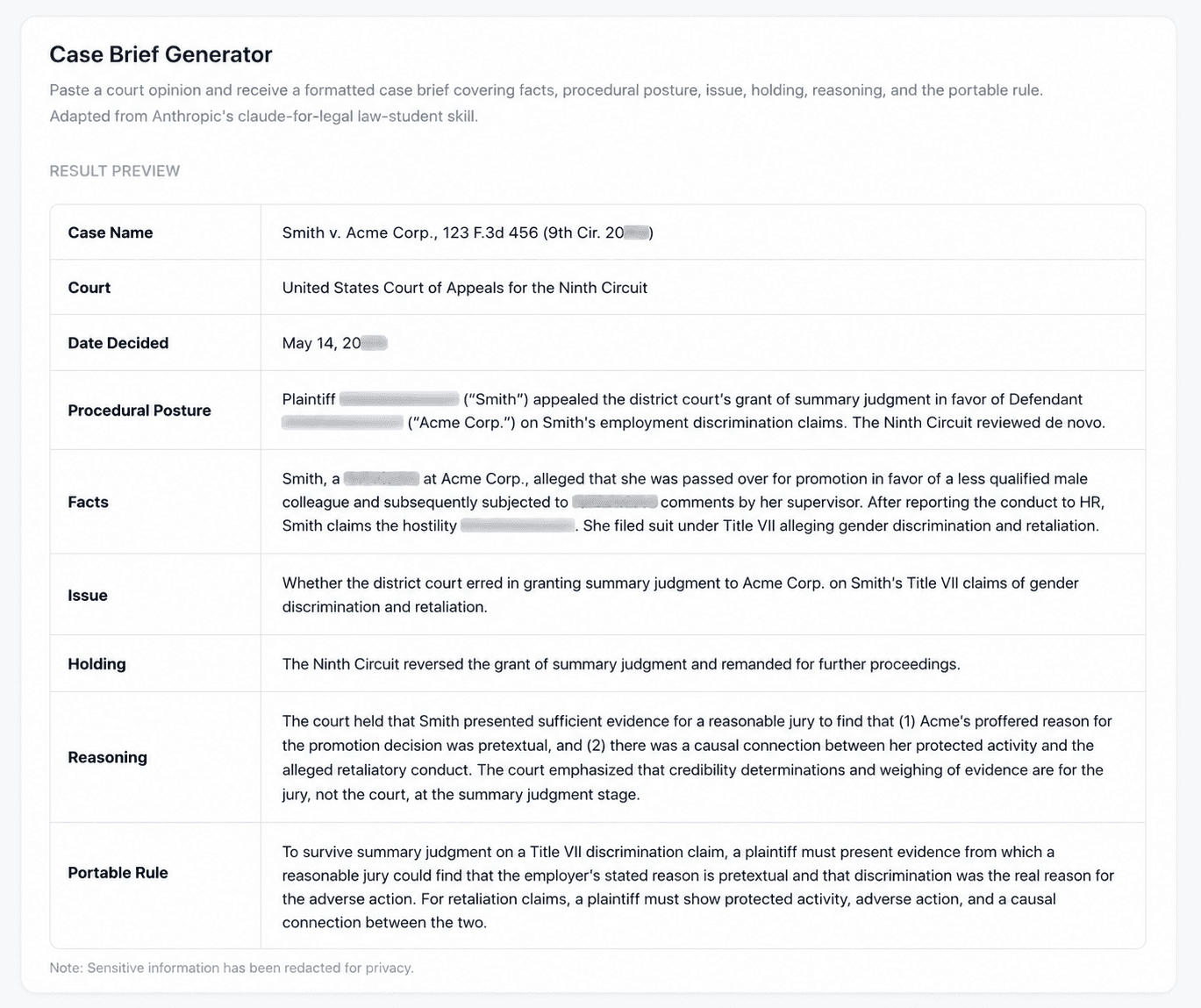
Paste any court opinion — from a landmark Supreme Court decision to a recent circuit court ruling — and receive a complete, structured brief covering all the traditional components: Facts, Procedural Posture, Issue Presented, Holding, Court's Reasoning, and the Portable Rule. The portable rule section is particularly valuable: it distills the holding into a general legal principle that can be applied to future fact patterns.
The brief format follows the IRAC-adjacent structure used in law school and legal practice. Each section is clearly labeled so you can quickly find the part you need. The tool is equally useful for reading landmark constitutional cases, statutory interpretation disputes, contract law decisions, and procedural rulings.
This tool was adapted from Anthropic's open-source claude-for-legal law-student skill library (Apache 2.0). It is designed for research and educational use only. If you name a case it cannot confirm, it is built to tell you so rather than guess. Always verify citations and holdings against authoritative legal databases before reliance.
Example Input & Output
How to Use This Tool
- 1Paste the full text of a court opinion into the input box, or enter the case name and citation (e.g., 'Marbury v. Madison, 5 U.S. 137 (1803)') and Claude will work from its training data
- 2Click 'Generate Case Brief' — the tool takes 20–35 seconds for longer opinions
- 3Review the six-section brief: Facts, Procedural Posture, Issue, Holding, Reasoning, and Portable Rule
- 4Use the brief for class preparation, research notes, or as a starting point for a legal memorandum — always verify key citations independently
Who This Tool Is For
- ✓Law students briefing cases for class preparation and final exams
- ✓Litigators summarizing opposing party's cited precedents to prepare counterarguments
- ✓Attorneys researching precedent in unfamiliar practice areas
- ✓Legal researchers building case libraries across multiple decisions
- ✓Paralegals summarizing decisions for supervising attorneys
- ✓Law professors generating sample briefs for teaching materials
Frequently Asked Questions
Can I use this for any court opinion — state or federal?
Yes — the tool works on federal and state court opinions, administrative agency decisions, and international court rulings written in English. Quality may vary for very old opinions with archaic legal language.
What if I only have the case citation, not the full text?
You can enter a case name and citation, and Claude will attempt to brief it from its training data. However, Claude's training data has a cutoff date, and it may not have recent or lower-court decisions. For recent cases, paste the full opinion text from a legal database.
Will the brief be accurate enough to use in class or for research?
The brief is an excellent starting point, but AI can mischaracterize holdings or miss nuanced reasoning. Always compare the AI brief against the actual opinion before presenting it in class or using it in legal work.
Will the tool make up a case or a holding?
It is instructed not to. When you give only a case name and citation, it relies on what the AI model already knows. If it cannot confirm that the case exists as cited, it tells you so and explains how to check, instead of writing a brief. In our own test with a made-up case, it declined to describe any facts or holding. No AI tool can guarantee accuracy, though. Treat every brief as a starting point, and check it against the actual opinion before you rely on it or cite it anywhere.
What is the 'portable rule' section?
The portable rule distills the holding into a general legal principle — the black-letter rule that future courts can apply to similar fact patterns. It is the most transferable part of the case for legal argument and memo writing.
Is this free to use?
You can run one free analysis per day before upgrading. The tool is powered by Claude, Anthropic's AI model.