OSS License Checker
Paste a dependency list (package.json, requirements.txt, etc.) or describe your software stack and deployment model. Receive a compliance memo classifying each license, mapping obligations to your deployment, and flagging critical issues. Adapted from Anthropic's claude-for-legal IP skill.
Free to try — one analysis per day before upgrading. Outputs are legal information, not legal advice.
Drag & drop a file here, or click to browse
Your content stays private. What you paste or upload is sent directly to Claude (Anthropic's AI) to generate the analysis — it is never stored on our servers, logged to a database, or seen by our team. Anthropic processes it under their Privacy Policy. Do not submit confidential or highly sensitive information unless your organization's AI use policy permits it.
Legal information, not legal advice. This tool helps you understand your situation and prepare your next steps — it does not replace advice from a lawyer who knows your full circumstances. Verify anything important against official sources, and consult a licensed attorney before decisions with significant legal or financial consequences. Do not input confidential client information. Outputs are generated by Claude and may contain errors.
What Is the OSS License Checker?
Open source software powers virtually every modern application — but using open source without understanding the license obligations can create serious legal exposure. Copyleft licenses like the GPL can require you to open-source your own proprietary code. Other licenses have attribution, patent, or compatibility requirements. The OSS License Checker analyzes your dependency list and maps the obligations to your specific deployment model.
Paste your package.json, requirements.txt, go.mod, Gemfile, or any dependency manifest, and describe how you deploy your software (SaaS, distributed binary, internal use, embedded in hardware). The tool classifies each license (permissive, weak copyleft, strong copyleft, proprietary-compatible), identifies the specific obligations triggered by your deployment model, and flags critical compatibility or compliance issues.
The analysis covers the most common open source licenses: MIT, Apache 2.0, BSD variants, LGPL, GPL v2 and v3, AGPL, MPL 2.0, CDDL, and others. It explains what each license requires — attribution notices, source disclosure, license compatibility restrictions — and whether those obligations apply to your use case.
Two limits worth knowing before you rely on this. A manifest lists your direct dependencies, but license risk usually arrives through transitive ones — a permissive package that pulls in a copyleft package several levels down. Run your own dependency tree for a complete picture. And the analysis reflects the general shape of each license, not your specific facts; compliance turns on details like whether two components form a single work, which is exactly where OSS disputes happen. Treat the memo as triage that tells you where to look, and bring an IP attorney to anything it flags as critical.
Example Output
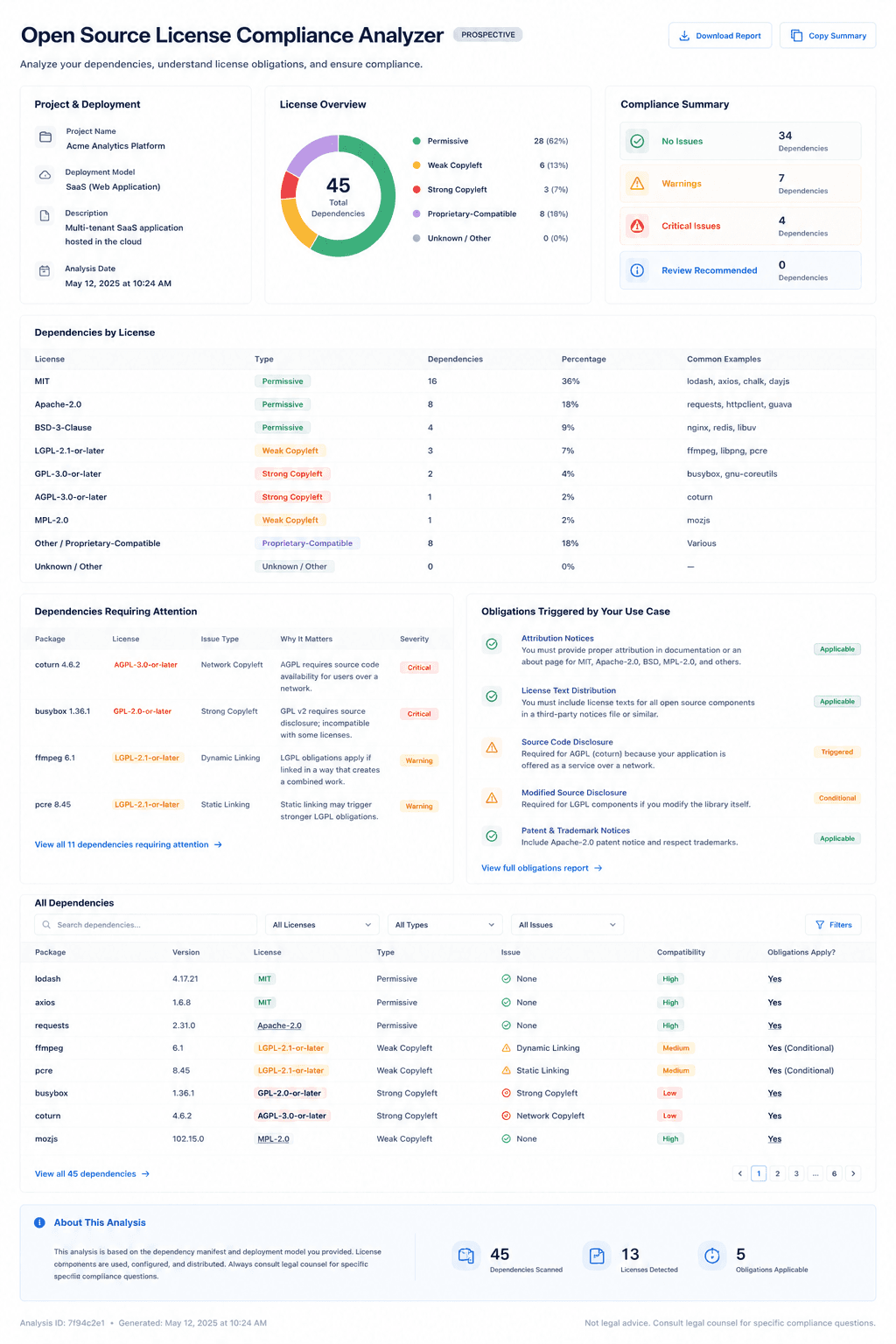
How to Use This Tool
- 1Paste your dependency manifest (package.json, requirements.txt, go.mod, etc.) into the input box
- 2Add a brief description of your deployment model: SaaS (server-side only), distributed binary (users download and install), internal use only, or embedded in hardware
- 3Click 'Generate OSS Compliance Memo' and allow 25–40 seconds
- 4Review the license classification for each dependency, the obligations triggered by your deployment model, and any critical flags — then consult an IP attorney for complex situations
Who This Tool Is For
- ✓Software engineers conducting a preliminary OSS compliance audit before a product launch
- ✓Startup legal teams assessing license obligations before a fundraising due diligence process
- ✓In-house counsel triaging open source use in a newly acquired company's codebase
- ✓CTO and engineering leads evaluating whether a dependency's license is compatible with a commercial product
- ✓Legal operations teams building repeatable OSS review workflows
- ✓M&A attorneys doing preliminary IP due diligence on a target company's software stack
Frequently Asked Questions
What licenses does this tool cover?
The tool covers the major open source licenses: MIT, Apache 2.0, BSD 2-Clause and 3-Clause, ISC, MPL 2.0, LGPL v2 and v3, GPL v2 and v3, AGPL v3, CDDL, EPL, and common proprietary licenses. It also handles dual-licensed packages where relevant.
Why does the deployment model matter for license obligations?
Copyleft obligations are often triggered by distribution, not by use. A GPL-licensed library used only internally may impose no distribution obligations. The same library, if included in a binary distributed to customers, may require you to release your source code. The deployment model is the key variable.
Does the AGPL really require open-sourcing a SaaS application?
Roughly, but the mechanism is often described wrong. Network access is not "distribution" under the GPL family — Section 13 of the AGPL v3 exists precisely because it is not. What Section 13 adds is a separate obligation: if you modify the program and let users interact with it over a network, you must offer those users the Corresponding Source of your modified version. Two things follow. The obligation runs to your users, not to the public at large. And how far it reaches into your own code turns on whether your code and the AGPL code form a single combined work — which is the genuinely contested question. If AGPL dependencies appear in your stack, this is worth an IP attorney rather than a judgment call.
Can I use this for M&A due diligence?
This tool provides a useful preliminary overview, but M&A OSS due diligence requires a comprehensive audit of the full codebase (including transitive dependencies) and legal review of any non-standard licenses. Use this as a first-pass triage tool, not as a definitive due diligence report.