Demand Letter Drafter
Describe the situation, the parties, the basis for your claim, and what you are demanding. Receive a complete demand letter draft in standard format, plus a checklist of everything to verify and fill in before you send it.
Free to try — one analysis per day before upgrading. Outputs are legal information, not legal advice.
Drag & drop a file here, or click to browse
Your content stays private. What you paste or upload is sent directly to Claude (Anthropic's AI) to generate the analysis — it is never stored on our servers, logged to a database, or seen by our team. Anthropic processes it under their Privacy Policy. Do not submit confidential or highly sensitive information unless your organization's AI use policy permits it.
Legal information, not legal advice. This tool helps you understand your situation and prepare your next steps — it does not replace advice from a lawyer who knows your full circumstances. Verify anything important against official sources, and consult a licensed attorney before decisions with significant legal or financial consequences. Do not input confidential client information. Outputs are generated by Claude and may contain errors.
What Is the Demand Letter Drafter?
A demand letter is often the first step in a legal dispute — and the way it is written matters. A well-drafted demand letter clearly states the legal basis for your claim, specifies what remedy you are seeking, sets a reasonable deadline, and signals that you are prepared to escalate if necessary. A poorly drafted one can damage your legal position, waive claims, or undermine credibility in subsequent litigation. This tool produces a professionally structured demand letter draft from your facts.
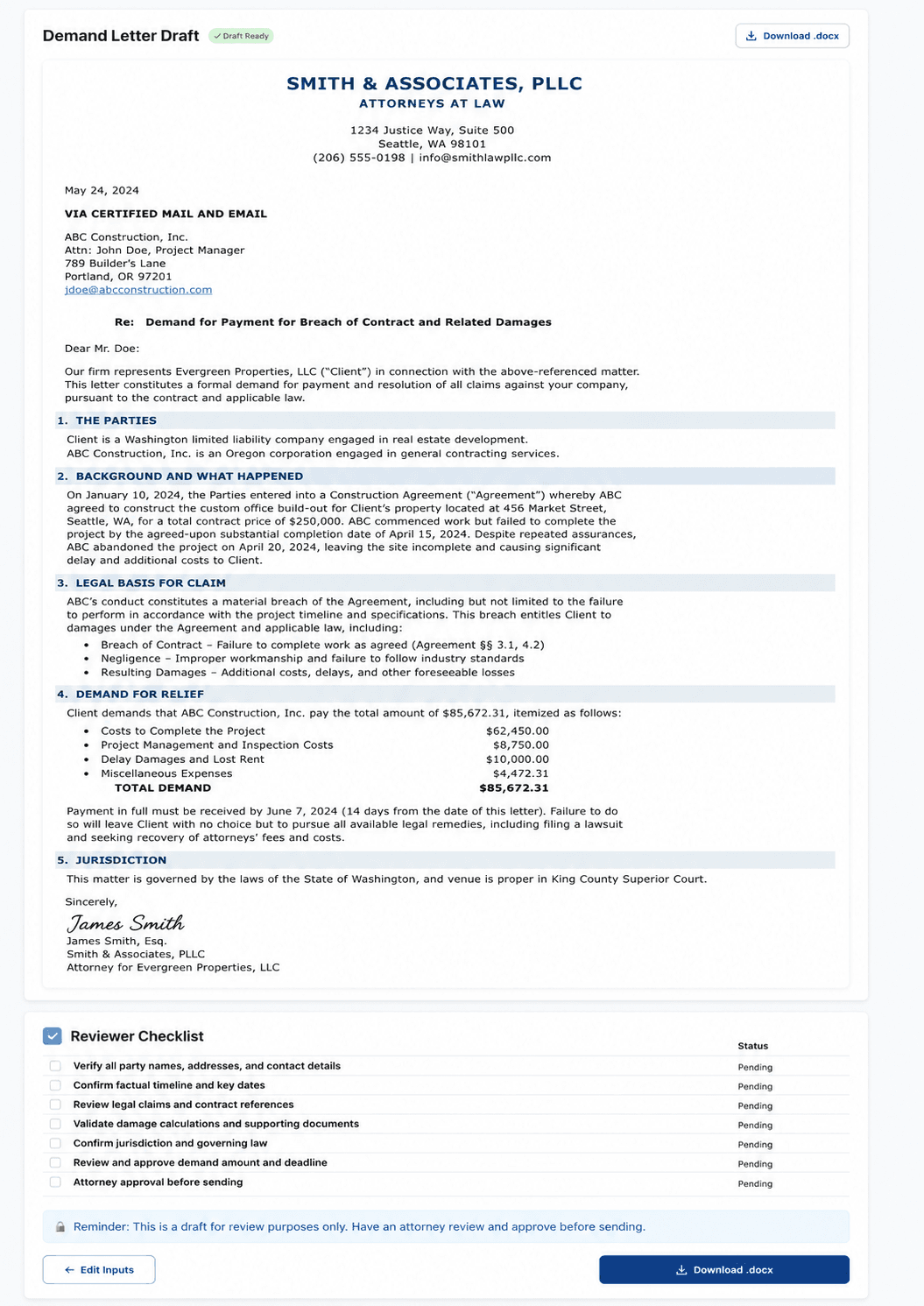
Describe the situation: who the claim is against, what happened, what law or contract provision was violated, what specific remedy you are demanding (a dollar amount, specific performance, corrective action), and the deadline you are setting. The tool produces a complete demand letter draft in standard legal format, including a professional tone, factual summary, legal basis for the claim, specific demand, and deadline with consequences for non-compliance.
The output also includes a checklist of what to verify before sending: whether the limitation period on your claim has run, whether you are filing in the right place, whether the amount you are demanding matches what you can actually document, and what you might be giving up by accepting it. The draft marks every fact it could not confirm, so you are never asked to send something you have not checked.
Sending a demand letter yourself is normal and lawful — small claims courts are designed for people without lawyers, and a clear letter often resolves the matter before any filing. That said, a demand letter has consequences: it can be used as evidence later, it can prompt a counterclaim, and accepting what you ask for may end your ability to claim more. So read the draft properly, resolve every item it flags, and bring in a lawyer or a free legal clinic when the amount is large relative to what you can afford to lose, when the other side already has counsel, or when the claim may exceed your local small claims limit.
Example Output
How to Use This Tool
- 1Describe the situation in detail: who you are, who the claim is against, what happened (chronologically), what legal right or contract provision was violated, and what jurisdiction applies
- 2State your specific demand clearly: the dollar amount owed, the specific action required, or the corrective measure you are seeking, and the deadline you want to set
- 3Click 'Generate Demand Letter Draft' and allow 25–35 seconds
- 4Work through every [VERIFY] marker and the gaps list — the draft deliberately leaves blanks rather than guessing at facts — then read the finished letter start to finish before sending it
Who This Tool Is For
- ✓Small business owners pursuing unpaid invoices or breach of contract claims
- ✓Individuals seeking refunds or compensation for defective goods or services
- ✓Landlords or tenants formalizing claims related to lease disputes
- ✓Freelancers and contractors chasing an invoice a client has stopped paying
- ✓Attorneys producing a first draft for client review before refining and sending
- ✓Contractors seeking payment for completed work under a written or oral agreement
Frequently Asked Questions
Is a demand letter the same as filing a lawsuit?
No — a demand letter is a pre-litigation communication requesting a remedy. It is not a court filing. However, it signals that litigation may follow if the demand is not met, and it can be used as evidence in subsequent proceedings. Many disputes are resolved through demand letters without ever reaching court.
What should a demand letter include?
A properly structured demand letter includes: the sender's identity and contact information, the recipient's identity, a factual summary of the dispute, the specific legal basis for the claim (contract provision, statute, or common law theory), a specific demand (amount, action, timeline), a clear deadline, and a statement of the consequences of non-compliance.
Do I need a lawyer to send a demand letter?
No. Sending one yourself is ordinary and lawful, and for the kinds of disputes small claims courts handle — unpaid invoices, withheld deposits, defective work — it is what most people do. Paying for a lawyer to review a letter over a few thousand dollars can cost a real fraction of the claim. Legal advice is worth buying when the stakes justify it: the amount is significant relative to what you can afford to lose, the other side already has counsel, you may be waiving a larger claim by accepting what you ask for, or the dispute could exceed your local small claims limit. Many areas also have free legal clinics for exactly this.
Can the other party use my demand letter against me in litigation?
Yes — demand letters can be introduced as evidence in litigation. This is one reason why the tone, factual accuracy, and legal basis of the letter are so important. An inaccurate statement in a demand letter can undermine your credibility in court.
What is the checklist included in the output?
It is what to confirm before you send: that the limitation period on your claim has not run, that you are naming the right party and the right court, that the amount you demand matches what you can document, that your legal basis is stated correctly, and whether the letter exposes you to a counterclaim. The draft also marks every fact it could not verify from your description, so nothing is invented to fill a gap.