Legal Research Roadmap
Describe a legal issue and jurisdiction. Receive a structured research roadmap: the statutes to check, case law areas to explore, search queries for free databases like CourtListener and Google Scholar (plus Westlaw and Lexis if you have access), and a prioritized research sequence.
Free to try — one analysis per day before upgrading. Outputs are legal information, not legal advice.
Drag & drop a file here, or click to browse
Your content stays private. What you paste or upload is sent directly to Claude (Anthropic's AI) to generate the analysis — it is never stored on our servers, logged to a database, or seen by our team. Anthropic processes it under their Privacy Policy. Do not submit confidential or highly sensitive information unless your organization's AI use policy permits it.
Legal information, not legal advice. This tool helps you understand your situation and prepare your next steps — it does not replace advice from a lawyer who knows your full circumstances. Verify anything important against official sources, and consult a licensed attorney before decisions with significant legal or financial consequences. Do not input confidential client information. Outputs are generated by Claude and may contain errors.
What Is the Legal Research Roadmap?
The hardest part of a legal question is usually knowing where to start. An experienced researcher checks the controlling statute before hunting for cases, knows which sources actually bind a court, and searches with terms that surface real authority instead of a flood of loosely related results. Most people do not know any of that, and end up reading whatever a search engine puts first. This tool gives you the structured approach instead.
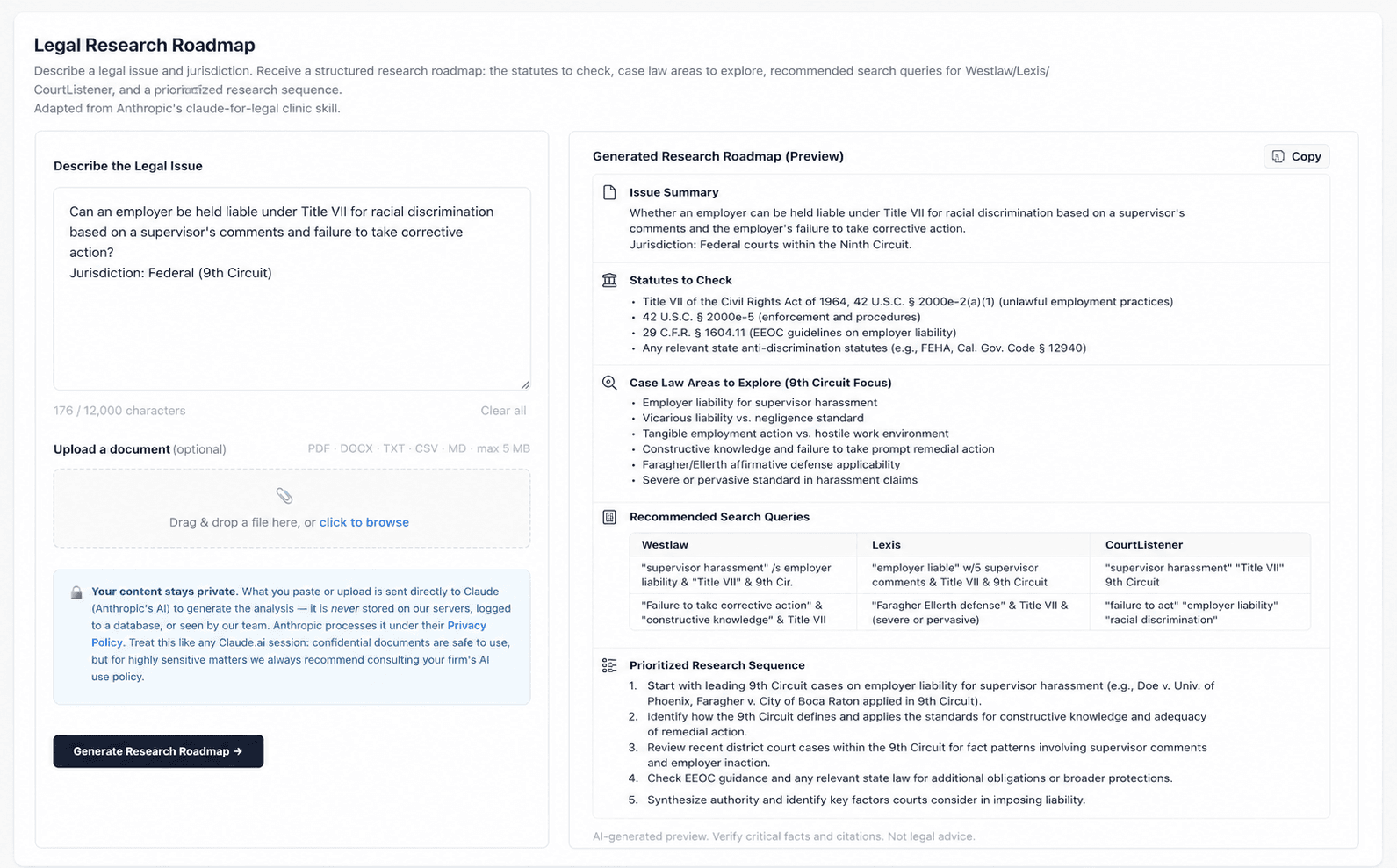
Describe the legal issue and jurisdiction, and the tool produces a complete roadmap: the primary statutes to check first, the areas of case law to explore, search queries written for free databases like CourtListener and Google Scholar as well as Westlaw and LexisNexis, secondary sources worth consulting, and a research sequence ordered from binding authority down to background reading.
This is useful whether or not you work in law. If you are handling your own dispute, the roadmap tells you which rules govern your situation and where to read them, so you stop guessing. If you work in a firm — as an attorney, paralegal, or clinic student — it structures and accelerates research in an unfamiliar practice area. The roadmap does not replace research; it tells you where to go and what to search before you open a database.
This tool was adapted from Anthropic's open-source claude-for-legal clinic skill library (Apache 2.0). The roadmap is a starting point — not a comprehensive research memo. All cited authorities and research paths should be verified and followed up using authoritative legal databases. This tool does not conduct research; it plans it.
Example Output
How to Use This Tool
- 1Describe the legal issue clearly: the core question, the jurisdiction (federal, specific state, or both), the parties and their relationship, and the relevant facts that give rise to the issue
- 2Note any constraints: is this for litigation, transactional advice, regulatory compliance, or academic research? The roadmap is calibrated differently for each
- 3Click 'Generate Research Roadmap' and allow 20–30 seconds
- 4Follow the roadmap in order — statutes first, then case law, then background sources. CourtListener and Google Scholar are free; Westlaw and LexisNexis work too if you have access
Who This Tool Is For
- ✓Anyone facing a dispute — a deposit, a contract, a workplace issue — who wants to know which rules actually apply before deciding what to do
- ✓People preparing for small claims court and figuring out what to look up and what to bring
- ✓Anyone about to meet a lawyer who wants to arrive with the right questions and use the hour well
- ✓Paralegals and law firm staff mapping out a research task before opening a database
- ✓Associates and solo practitioners starting research in an unfamiliar practice area
- ✓Law students and clinic participants learning how experienced researchers structure a question
Frequently Asked Questions
Does this tool actually conduct legal research?
No — it produces a research plan, not research results. It tells you which statutes to check, which areas of case law to explore, and what search queries to run in legal databases. The actual research must be done by you using Westlaw, LexisNexis, CourtListener, or other legal research tools.
What is CourtListener?
CourtListener (courtlistener.com) is a free, open-access database of federal court opinions maintained by the Free Law Project. It covers federal district and circuit court opinions and all Supreme Court decisions. It is a valuable free alternative to Westlaw and Lexis for federal case research, though it does not include state court cases as comprehensively.
How should I prioritize sources in legal research?
Start with primary authority in your jurisdiction: the controlling statute, then constitutional provisions if relevant, then administrative regulations. Then move to primary case law interpreting those sources, starting with the highest court in your jurisdiction. Secondary sources (treatises, law review articles, restatements) are useful for understanding doctrine but are not binding authority.
Can this roadmap work for any jurisdiction?
Yes — you can specify any U.S. state or federal jurisdiction, and the tool will identify the relevant primary sources for that jurisdiction. For international legal issues, the tool provides a more general framework since it is primarily trained on U.S. legal materials.
Is this useful for law students?
Absolutely — this tool is an excellent learning aid for 1Ls and 2Ls developing legal research skills. It models the thought process of an experienced researcher approaching a new issue: identifying the primary sources, understanding the research hierarchy, and generating effective database search queries.