Marketing Claims Checker
Paste your marketing copy, ad text, or landing page content. Receive a claim-by-claim analysis flagging false advertising risks, unsubstantiated claims, missing FTC disclosures, and specific rewrite suggestions. Adapted from Anthropic's claude-for-legal product-legal skill.
Free to try — one analysis per day before upgrading. Outputs are legal information, not legal advice.
Drag & drop a file here, or click to browse
Your content stays private. What you paste or upload is sent directly to Claude (Anthropic's AI) to generate the analysis — it is never stored on our servers, logged to a database, or seen by our team. Anthropic processes it under their Privacy Policy. Do not submit confidential or highly sensitive information unless your organization's AI use policy permits it.
Legal information, not legal advice. This tool helps you understand your situation and prepare your next steps — it does not replace advice from a lawyer who knows your full circumstances. Verify anything important against official sources, and consult a licensed attorney before decisions with significant legal or financial consequences. Do not input confidential client information. Outputs are generated by Claude and may contain errors.
What Is the Marketing Claims Checker?
Marketing copy that makes unsupported claims, misleads consumers, or fails to include required disclosures can expose a company to FTC enforcement, class action lawsuits, and regulatory fines. The FTC's standards for advertising substantiation require that objective claims about a product's performance, safety, or benefits be backed by competent and reliable evidence before the claim is made — not after. This tool reviews your marketing copy before it goes live.
Paste your landing page copy, ad creative, email campaign text, product descriptions, or social media content. The tool performs a claim-by-claim analysis: it identifies every factual claim, assesses whether it appears substantiated or at risk, flags superlative and comparative claims that require strong evidence, identifies testimonials and endorsements that need FTC disclosure, and suggests specific rewrites that reduce legal risk while preserving marketing impact.
The review covers key compliance areas: FTC truth-in-advertising standards, endorsement and testimonial disclosure requirements (including influencer disclosures), health and safety claim substantiation, comparative advertising standards, pricing and discount claim requirements, and consumer protection principles applicable to digital advertising.
This tool is adapted from Anthropic's open-source claude-for-legal product-legal skill library (Apache 2.0). It provides an initial risk assessment and is not a substitute for review by a qualified advertising or consumer protection attorney. Regulatory standards vary by industry, jurisdiction, and claim type.
Example Output
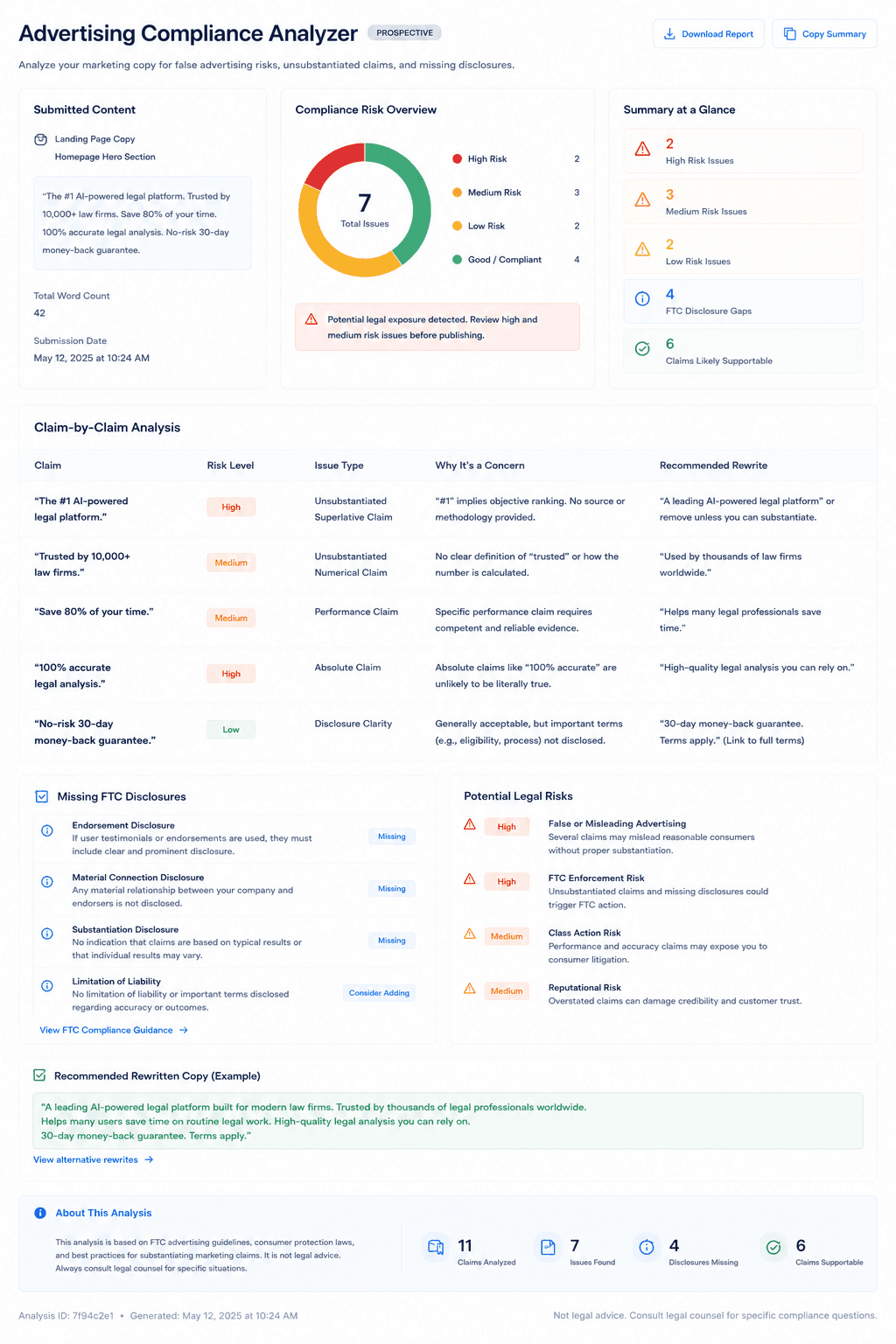
How to Use This Tool
- 1Paste your marketing copy — ad text, landing page content, email, product description, or social media post
- 2Optionally note your industry (e.g., health/wellness, financial services, technology) as FTC scrutiny varies significantly by sector
- 3Click 'Generate Claims Review' and allow 20–30 seconds
- 4Review each flagged claim, the risk assessment, and the suggested rewrite — then consult a marketing attorney before publishing
Who This Tool Is For
- ✓Marketing teams reviewing landing page copy before a product launch for regulatory risk
- ✓Growth and demand generation managers auditing ad copy for FTC compliance
- ✓In-house legal counsel conducting pre-publication review of marketing materials
- ✓E-commerce brands checking product description claims for substantiation issues
- ✓Startups in regulated industries (health, finance, supplements) screening marketing content
- ✓Agencies conducting compliance reviews of client creative before submission
Frequently Asked Questions
What types of claims does this tool flag?
The tool flags: unsubstantiated objective claims ('our product is 10x faster'), superlatives without support ('the best,' 'the most effective'), comparative claims ('better than competitor X'), testimonials and endorsements that need disclosure, pricing and savings claims ('save 50%'), and health or safety claims that require clinical substantiation.
What FTC disclosures are commonly required?
Common FTC disclosure requirements include: disclosing material connections between endorsers and brands (influencer posts, affiliate relationships), disclosing that testimonials represent non-typical results, disclosing material terms of offers, and disclosing when a 'review' site has commercial relationships with reviewed products.
Is this tool relevant outside the United States?
The tool primarily applies FTC (U.S.) and general consumer protection standards. The UK ASA, EU consumer protection regulations, and other jurisdictions have different requirements. For international campaigns, consult local counsel in addition to using this tool.
Does this guarantee my marketing copy is compliant?
No — this tool provides an initial risk assessment. Regulatory compliance is highly fact-specific and depends on your industry, claim type, and available substantiation. Always have marketing materials in regulated industries reviewed by a qualified attorney before publication.