Privacy Policy Analyzer
Paste your privacy policy and receive a compliance gap analysis against GDPR, CCPA/CPRA, and general best practices. Identifies missing required disclosures, incomplete sections, and priority fixes. Adapted from Anthropic's claude-for-legal privacy skill.
Free to try — one analysis per day before upgrading. Outputs are legal information, not legal advice.
Drag & drop a file here, or click to browse
Your content stays private. What you paste or upload is sent directly to Claude (Anthropic's AI) to generate the analysis — it is never stored on our servers, logged to a database, or seen by our team. Anthropic processes it under their Privacy Policy. Do not submit confidential or highly sensitive information unless your organization's AI use policy permits it.
Legal information, not legal advice. This tool helps you understand your situation and prepare your next steps — it does not replace advice from a lawyer who knows your full circumstances. Verify anything important against official sources, and consult a licensed attorney before decisions with significant legal or financial consequences. Do not input confidential client information. Outputs are generated by Claude and may contain errors.
What Is the Privacy Policy Analyzer?
Privacy regulations have created a complex web of disclosure requirements that privacy policies must satisfy. The GDPR requires companies to disclose the lawful basis for processing, data subject rights, international transfer safeguards, and retention periods. CCPA/CPRA adds California-specific requirements including the right to opt out of sale, the right to limit use of sensitive personal information, and mandatory disclosures about data sharing. A privacy policy that was adequate in 2020 may be materially non-compliant today.
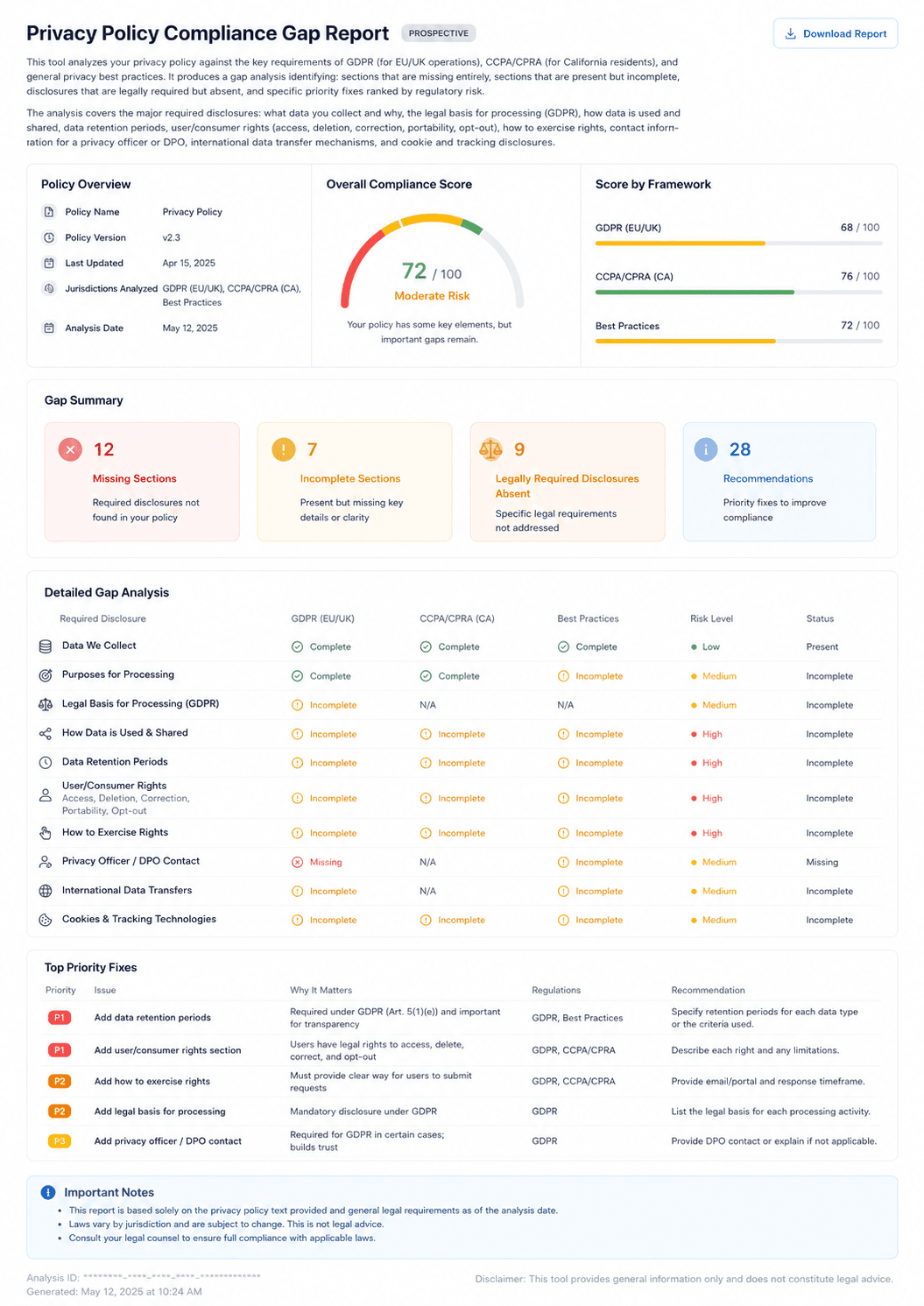
This tool analyzes your privacy policy against the key requirements of GDPR (for EU/UK operations), CCPA/CPRA (for California residents), and general privacy best practices. It produces a gap analysis identifying: sections that are missing entirely, sections that are present but incomplete, disclosures that are legally required but absent, and specific priority fixes ranked by regulatory risk.
The analysis covers the major required disclosures: what data you collect and why, the legal basis for processing (GDPR), how data is used and shared, data retention periods, user/consumer rights (access, deletion, correction, portability, opt-out), how to exercise rights, contact information for a privacy officer or DPO, international data transfer mechanisms, and cookie and tracking disclosures.
This tool was adapted from Anthropic's open-source claude-for-legal privacy skill library (Apache 2.0). It reads the policy text only — it cannot see what your systems actually collect, so a policy can pass this review and still misdescribe your real data practices, which is itself the violation regulators pursue most often. Treat the report as a check on your disclosures, not on your processing. Privacy law also varies by jurisdiction and changes quickly; anything flagged critical is worth a privacy attorney or CIPP.
Example Output
How to Use This Tool
- 1Paste your current privacy policy text (or a draft policy if you are writing one from scratch)
- 2Optionally note which regulations are most relevant to your business (GDPR, CCPA, both, or other) and whether you process sensitive categories of personal data
- 3Click 'Generate Compliance Gap Report' and allow 25–40 seconds
- 4Work through the gaps in priority order — missing disclosures are usually fixable by editing the policy text, while anything touching lawful basis, international transfers, or sensitive data is worth professional review before you publish
Who This Tool Is For
- ✓Startups conducting a pre-launch privacy policy review before going live
- ✓In-house legal and privacy teams auditing an existing privacy policy for GDPR or CCPA compliance gaps
- ✓Small businesses assessing whether their privacy policy meets basic legal requirements
- ✓Product managers and engineers reviewing data practices against policy disclosures
- ✓Compliance teams preparing for privacy audits or regulatory inquiries
- ✓Legal counsel reviewing a target company's privacy posture during M&A due diligence
Frequently Asked Questions
What privacy laws does this tool check against?
Mainly the EU GDPR and CCPA/CPRA (California Consumer Privacy Act, as amended by the California Privacy Rights Act), plus PIPEDA for Canada and general best practices. Note that the UK has kept its own UK GDPR since Brexit — the disclosure requirements still line up closely with the EU version, so the analysis remains useful, but they are separate statutes that can diverge over time.
My business is small. Do I really need to comply with GDPR?
GDPR applies to any organization that processes personal data of EU/UK residents, regardless of where the organization is based. If your website or service is accessible to EU/UK users and collects any personal data (including IP addresses via cookies), GDPR requirements may apply. Consult a privacy attorney if you are unsure.
What is the difference between CCPA and CPRA?
The CCPA (effective 2020) established foundational California consumer privacy rights. The CPRA (effective 2023) significantly expanded those rights, adding the right to correct data, the right to limit use of sensitive personal information, and creating the California Privacy Protection Agency (CPPA) as a dedicated enforcement body. The tool accounts for CPRA requirements.
Does this tool check for cookie consent compliance?
Yes — the tool reviews cookie and tracking disclosures in your privacy policy, including whether you disclose the categories of cookies used, provide an opt-out mechanism, and comply with GDPR consent requirements for non-essential cookies. However, a full cookie compliance review requires assessment of your actual cookie implementation, not just your policy text.
Is this tool free?
You can run one free analysis per day before upgrading. Powered by Claude AI.