Worker Classification Checker
Describe a working arrangement — one you are planning or one already running — and receive an analysis under the IRS Common Law test, ABC test (CA/MA/NJ), and FLSA Economic Realities test. Identifies which factors support IC status and which create misclassification risk. Adapted from Anthropic's claude-for-legal employment skill.
Free to try — one analysis per day before upgrading. Outputs are legal information, not legal advice.
Drag & drop a file here, or click to browse
Your content stays private. What you paste or upload is sent directly to Claude (Anthropic's AI) to generate the analysis — it is never stored on our servers, logged to a database, or seen by our team. Anthropic processes it under their Privacy Policy. Do not submit confidential or highly sensitive information unless your organization's AI use policy permits it.
Legal information, not legal advice. This tool helps you understand your situation and prepare your next steps — it does not replace advice from a lawyer who knows your full circumstances. Verify anything important against official sources, and consult a licensed attorney before decisions with significant legal or financial consequences. Do not input confidential client information. Outputs are generated by Claude and may contain errors.
What Is the Worker Classification Checker?
Misclassifying an employee as an independent contractor is one of the most expensive legal mistakes a business can make. The penalties include back taxes and penalties from the IRS, state unemployment and workers' compensation liability, FLSA overtime back pay, benefits liability, class action exposure, and potential criminal charges in egregious cases. Worker classification analysis — understanding which legal tests apply and how a proposed arrangement scores against them — is essential before engaging any contractor.
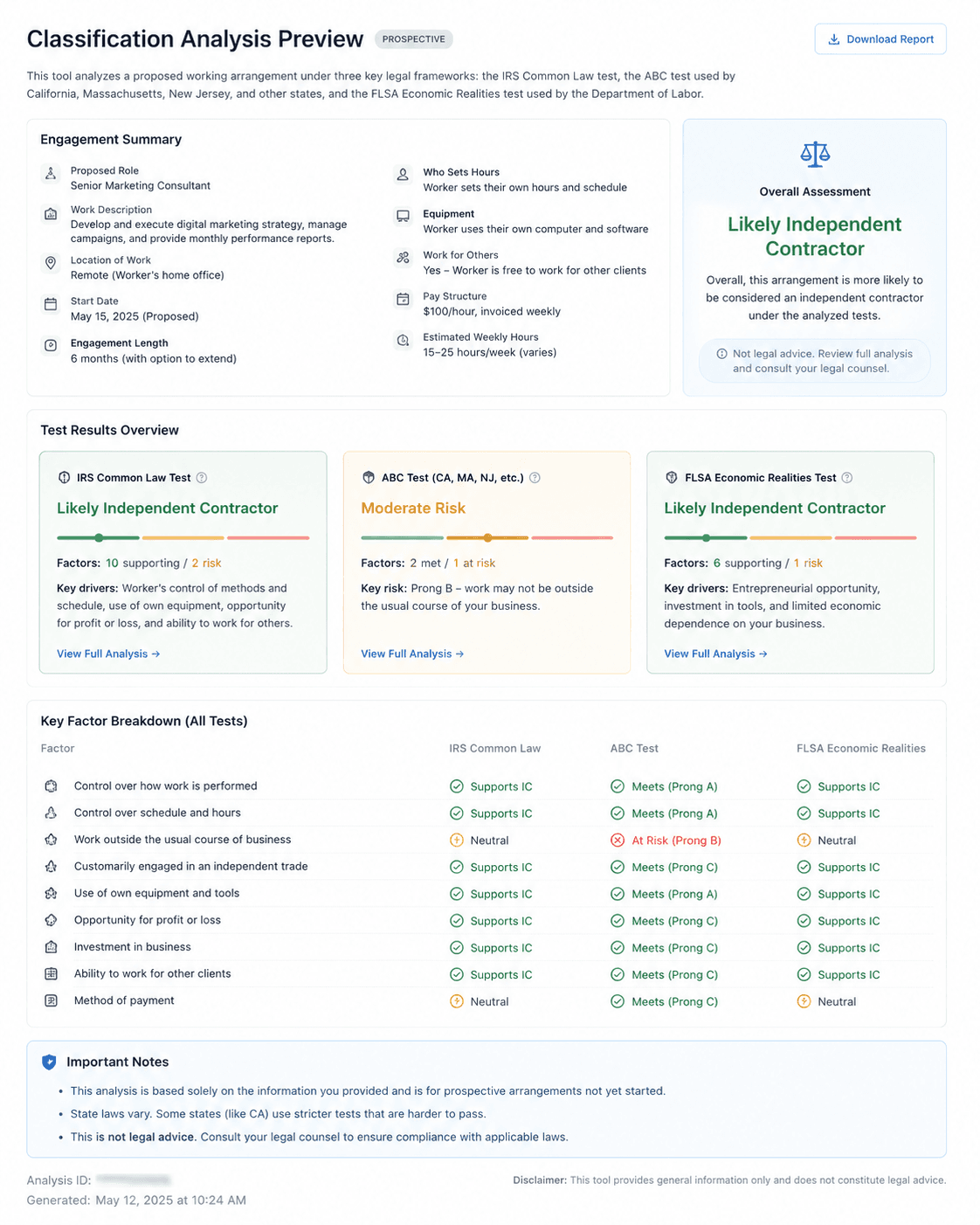
This tool analyzes a proposed working arrangement under three key legal frameworks: the IRS Common Law test (the primary test for federal tax purposes), the ABC test used by California, Massachusetts, New Jersey, and other states (which imposes a strict presumption of employment), and the FLSA Economic Realities test used by the Department of Labor for wage and hour purposes. Each test weighs different factors, and a single arrangement can fail one test while passing another.
Describe the proposed engagement in detail: what work the person will do, who controls the hours and methods, whether they use your equipment or their own, whether they work for other clients, how they are paid, and where the work takes place. The more specific your description, the more useful the analysis. The tool identifies which factors support independent contractor status and which create misclassification risk — giving you a factual roadmap for structuring the engagement.
The tool handles both situations, and they are not the same. For an arrangement you are still designing, the analysis is a roadmap: it shows which factors to change so the engagement holds up. For one already running, it is a risk assessment — misclassification liability accrues from the start of the relationship, not from the day you notice, so back wages, unpaid overtime, unreimbursed expenses, and payroll tax exposure may already exist. Say how long the arrangement has been in place and the analysis will account for it. Either way this is legal information, not legal advice, and an existing arrangement that scores badly is worth an employment attorney promptly rather than eventually.
Example Output
How to Use This Tool
- 1Describe the proposed working arrangement in detail: the work to be done, who controls hours and methods, equipment used, other clients the worker has, payment structure, and work location
- 2Note the state(s) where the work will occur — the ABC test applies in California, Massachusetts, New Jersey, and others, making classification significantly harder
- 3Click 'Generate Classification Analysis' and allow 25–35 seconds
- 4Review the factor-by-factor analysis for each applicable test, the overall risk assessment, and the recommendations for structuring the engagement — then consult an employment attorney
Who This Tool Is For
- ✓Business owners worried about a contractor they have already been paying as a 1099 for months
- ✓Startups evaluating whether to engage a developer, designer, or content creator as a contractor or employee
- ✓HR and legal teams assessing the misclassification risk of a proposed gig worker engagement
- ✓Businesses expanding into California or other ABC test states evaluating contractor arrangements
- ✓Small business owners deciding whether to hire staff or engage service providers
- ✓Operations teams reviewing contractor arrangements for compliance risk before an audit
- ✓M&A counsel assessing target company contractor workforce for classification liability
Frequently Asked Questions
What is the ABC test and why does it matter for California?
California's ABC test (Labor Code § 2775) presumes every worker is an employee unless the hiring entity can prove all three prongs: (A) the worker is free from control; (B) the work is outside the company's core business; (C) the worker has an independently established business. Prong B is extremely difficult for most arrangements and is why California is one of the hardest states for IC classification.
Which states use the ABC test?
As of 2026, states with strict ABC-style tests include California, Massachusetts, New Jersey, Vermont, Connecticut, Illinois, and others. The specific prongs vary by state. Always identify the applicable state law for each engagement.
Can one working arrangement fail one test but pass another?
Yes — and this happens frequently. An arrangement may satisfy the IRS Common Law test (for federal tax purposes) but fail California's ABC test (for state labor law purposes). This creates a situation where the worker is a contractor for IRS purposes but an employee under California law, exposing the company to state-level liability.
Is this tool useful for gig economy and platform businesses?
Yes — gig and platform businesses face the most aggressive worker classification enforcement. This tool provides useful preliminary analysis, but platform businesses should work with specialized employment counsel given the rapidly evolving regulatory landscape.
Can I use this for a contractor I already have?
Yes, and most people asking this question are in exactly that position. Tell the tool how long the arrangement has been running and it will assess it as existing exposure rather than as a design question. Two cautions. The tests look at actual conduct over time, so the analysis is only as good as your description of how the relationship really works — not how the contract describes it. And reclassifying someone, or changing the arrangement after a bad result, has its own consequences for back pay and taxes; get an employment attorney involved before you restructure rather than after.